Gardens on Living Branches
In cloud forests, the biomass of plants growing upon other plants often matches or exceeds the foliage weight of the host trees themselves.
Specialized Epiphytic Adaptations
Velamen Radicum in Montane Orchids
Orchid roots possess a multi-layered dead epidermis called velamen radicum. When dry, cells fill with air; upon contact with mist, capillary suction draws liquid inward within seconds, locking in dissolved atmospheric nutrients.
Genera: Lepanthes, Stelis, MasdevalliaPoikilohydry in Bryophytes and Liverworts
Unlike vascular trees that regulate internal water pressure with guard cells, mosses and liverworts are poikilohydric. They desiccate without tissue injury when fog clears and resume active photosynthesis minutes after mist returns.
Tolerance Range: Up to 90% Water LossFoliar Trichomes in Tillandsia
High-altitude bromeliads possess peltate scales on leaf blades. These microscopic shield-shaped trichomes open to collect condensing mist droplets and snap flat to prevent evaporation under midday sunlight.
Family: Bromeliaceae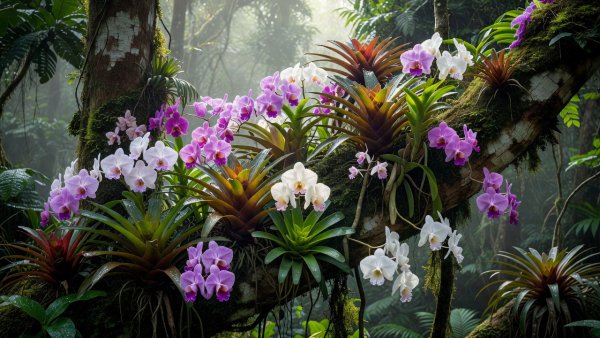
Carnivorous Pitcher Traps (Nepenthes)
In Southeast Asian montane heath and mossy summit zones, Nepenthes species produce specialized digestive fluid adapted to low nutrient soils, deriving nitrogen from insects lured into pendulous cups.
Dominant Plant Families of the Cloud Band
| Plant Group | Primary Habit | Water Intake Mechanism | Ecological Function |
|---|---|---|---|
| Pleurothallid Orchids | Branch epiphyte | Velamen-coated adventitious roots | Micro-pollinator support (phorid flies) |
| Tank Bromeliads | Trunk fork epiphyte | Foliar rosette holding impoundments | Canopy amphibian nurseries & insect refugia |
| Cyatheaceae (Tree Ferns) | Understory tree (to 12m) | Fibrous root trunk & broad fronds | Soil stabilization on 40°+ mountain inclines |
| Sphagnum & Plagiochila | Bark & boulder carpet | Capillary leaf-cell absorption | Occult moisture stripping & peat formation |
The Danger of Botanical Poaching
Because many cloud forest orchids and miniature ferns have evolved within isolated mountaintop microclimates—often occurring on only a single ridge—they are extremely susceptible to illegal collection. High humidity cannot be replicated in typical domestic settings, resulting in almost 100% mortality for poached specimens.
Field researchers and nature preserves strictly monitor photography metadata to avoid broadcasting precise GPS tags of rare miniature specimens.